Die Automobilindustrie befindet sich inmitten ihrer tiefgreifendsten und schnellsten Transformation seit einem Jahrhundert. Dieser Wandel betrifft nicht nur neue Modelle; er ist eine fundamentale Neukonstruktion des Fahrzeugs selbst und folglich des gesamten Aftermarket-Sektors. Für Branchenexperten, von Werkstattbesitzern bis zu Technikern, birgt dieser Moment sowohl beispiellose Herausforderungen als auch bedeutende Chancen. Der Übergang zu Elektro- (EV) und Hybridfahrzeugen ist eine der Säulen dieser Revolution und ein kritischer Bereich, der strategische Aufmerksamkeit erfordert.
Der unvermeidliche Wandel: Marktdynamik und die Entstehung eines dualen Kanals
The future of automotive is undeniably electric. This trend is driven by a combination of factors, from global regulations aimed at reducing carbon emissions to a shift in consumer preferences. The rise of EVs is quickly moving from a niche to a mainstream segment, with major automakers increasing production and governments implementing policies to accelerate adoption. While EV adoption in Italy is still slower than in other European countries, the direction is clear and must be proactively addressed. Technological advancements, particularly in solid-state battery technology, promise extended ranges of over 1,000 km and drastically reduced charging times, making EVs an increasingly practical and accessible choice for millions of customers.
Simultaneously, an equally significant phenomenon is shaping the market: the aging of the vehicle fleet. The average age of cars in the U.S. has risen to 12.8 years, a trend fueled by inflation, high prices for new and used vehicles, and increased borrowing costs. As a result, a growing number of internal combustion engine (ICE) vehicles are staying on the road for longer, creating a sustained and expanding demand for traditional maintenance and aftermarket parts. This creates a two-speed market: on one hand, a consolidated demand for traditional vehicle maintenance, and on the other, the emergence of a new and profitable segment for electric vehicles. A workshop that wishes to thrive must be able to operate in both markets, continuing to serve the existing clientele while developing the skills necessary to capture future, high-value workstreams.
Der neue Bauplan: Fähigkeiten und Sicherheit bei der Wartung von Elektrofahrzeugen
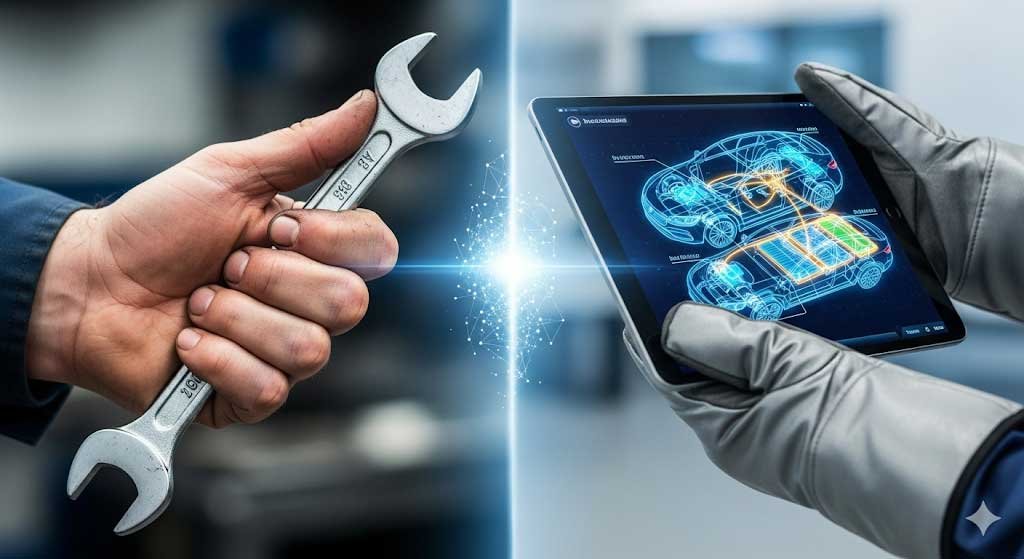
Servicing an EV is fundamentally different from servicing a traditional car. The absence of a combustion engine, drive belts, and numerous moving parts means that classic mechanical skills, while still useful, must be augmented with a new set of competencies. The most critical challenge is managing high-voltage systems, which can exceed 300 volts and pose a lethal electrocution risk if not handled with extreme caution and expertise. This aspect transforms the mechanic’s role from a combustion engine craftsman into a technician specializing in electronics and high-voltage systems.
Common problems in electric vehicles include battery degradation, charging system failures, and software glitches, requiring a completely different diagnostic approach. Technicians must master the diagnosis of complex electrical architectures and the use of specialized software to assess battery health and performance. Another often-overlooked peculiarity concerns tires. Due to the added weight of the battery and the instant torque of electric motors, EV tires are subject to faster wear, necessitating more frequent maintenance and rotation.
To meet these new challenges, industry professionals must view training and equipment not as costs, but as strategic investments in the future of their business. Preparation is not just a choice, but a safety requirement. In Italy, a PES/PAV qualification under the CEI 11-27 standard is required to work on high-voltage vehicles. These training courses, which can cost from a few hundred to over 1,750 euros, cover fundamental electrical safety principles, work procedures, and the use of personal protective equipment (PPE).
Similarly, specialized equipment is indispensable. Insulated tools, designed to withstand up to 1000V, are mandatory to prevent electric shocks. A high-voltage digital multimeter and specific tool carts for organizing insulated tools are part of the basic equipment for any state-of-the-art workshop. The high initial cost of training and equipment creates a barrier to entry, which in turn becomes a competitive advantage for those willing to invest. They not only ensure safety and service quality but also position themselves as experts in an emerging market, standing out from the competition and capturing a larger share of a rapidly growing segment. Today’s investment is the key to tomorrow’s prosperity.